First, check the gap isn't CIS or an agreed deduction by comparing the payment with your payment and deduction statement. If money really is missing, raise it in writing straight away, with your evidence: dates, rates, signed day sheets and photos. If the contractor still won't pay, the Construction Act is on your side, even without a written contract. They can only pay less with proper notice. You can suspend work after 7 days' written notice, and you can take the dispute to adjudication. You can also claim late payment interest, and use the small claims court for debts up to £10,000 in England and Wales.
1. Check it's really short
Before you ring anyone, make sure the gap isn't something that was supposed to come off. Compare what landed in the bank with your payment and deduction statement for that month.
| If the gap is… | It might be… |
|---|---|
| 20% or 30% of your labour | CIS. It's paid to HMRC for you, and counts towards your tax bill. |
| About 10% more than you expected | You're being charged 30% instead of 20%. See why that happens. |
| A small percentage held back | A retention, if you agreed to one. |
| The value of some materials | Materials the contractor supplied and is charging back. |
| Exactly one day or a half day | A day they don't think you worked, or one paid in a different week. |
If none of those explains it, money is missing. Don't wait: the sooner you raise it, the easier it is to sort out.
2. Get your evidence together
- The days and rates: which days, which site, what rate you agreed.
- Proof you were there: signed daywork sheets, timesheets, photos of the finished work.
- The agreement: a contract, a quote, or even texts or WhatsApp messages agreeing the rate.
- The money side: your statement or invoice, their payment and deduction statement, and your bank statement.
A record made on the day is much stronger than one put together weeks later from memory.
3. Ask in writing
Most short payments are mistakes, so start politely. A phone call is fine, but follow it up in writing (a text, WhatsApp or email) so you have a record. Keep it short and specific:
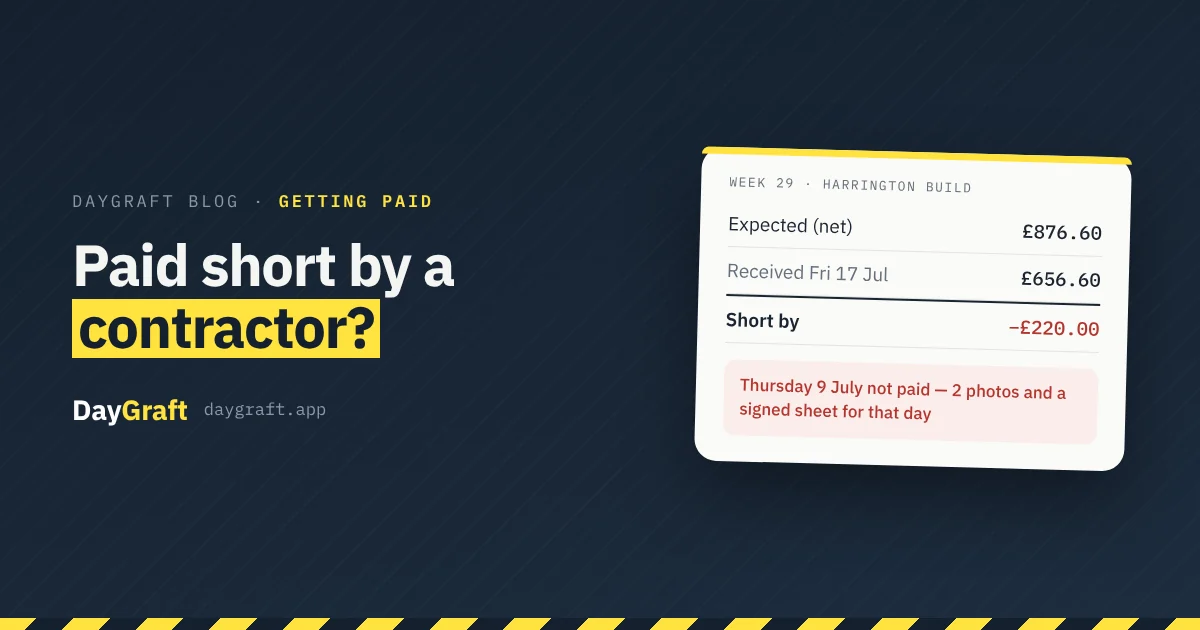
Hi Dave, the payment for week ending Friday 10 July came in at £656.60, but my statement shows £876.60 after CIS. That leaves £220.00 unpaid, which matches Thursday 9 July at Oakfield Rd. I've attached the statement and the signed day sheet. Can you let me know when the balance will be paid?
Give a clear date to reply by. If you hear nothing, follow up once more in writing before moving on.
4. Your rights under the Construction Act
The Housing Grants, Construction and Regeneration Act 1996 (the "Construction Act") covers most construction contracts in the UK, including work as a subcontractor for a contractor. Since 2011, it covers verbal agreements as well as written ones. It doesn't cover work you do directly for a homeowner on their own home.
They can only pay less with proper notice
If a contractor wants to pay less than the amount due, they have to send you a pay less notice in time, saying how much they'll pay and why. If they don't, they're usually required to pay the full amount that was notified. If your contract doesn't set out payment rules, a fallback set of rules (the Scheme for Construction Contracts) fills the gap.
You can suspend work
If you aren't paid the amount due by the final date for payment, you can stop work. You must give at least 7 days' written notice first, saying why. Get the notice right: a defective one can put you in the wrong, so it's worth getting advice before you down tools.
You can go to adjudication
Either side can refer a dispute to an independent adjudicator at any time. It usually takes about 28 days, and the decision is binding unless it's later overturned in court or by agreement. It's much faster than court, but there are fees, so it suits bigger amounts better than a single unpaid day.
5. Interest and compensation
Under the Late Payment of Commercial Debts (Interest) Act 1998, a business, including a self-employed sole trader, can usually claim interest on late payments from another business. If your contract doesn't say otherwise:
- payment is late after 30 days if no date was agreed
- you can claim interest at 8% above the Bank of England base rate
- you can add a fixed compensation sum: £40 for debts under £1,000, £70 for £1,000 to £9,999.99, and £100 for £10,000 or more
Mentioning this in a polite follow-up often gets things moving.
6. Letter before action and small claims
If talking doesn't work, send a letter before action: a formal letter setting out what's owed, why, and that you'll go to court if it isn't paid by a set date (14 days is common). Attach your evidence.
If they still don't pay, you can make a claim through the small claims track. In England and Wales, it handles debts up to £10,000, you can start it online with Money Claim Online, and you don't need a solicitor. There's a court fee based on the amount, which you can usually add to your claim. Scotland and Northern Ireland have their own small claims procedures, with different limits.
Stopping it happening again
- Agree the rate in writing before you start. A text saying "£220 a day, paid weekly" is far better than nothing.
- Send a statement every week, so there's a clear record of what you're owed.
- Check every payment as it lands, not at the end of the month.
- Don't let a debt build up. Two unpaid weeks is a warning sign. Six is a problem.
- Keep proof on the day: signed sheets and photos.
How DayGraft helps
This is the problem DayGraft was built for. Each day is logged with the site, rate and photos or a signed sheet attached. One tap turns the week into a statement with the CIS worked out, with the evidence added at the back if you want it. When the money lands, enter what you received. DayGraft compares it with what you were owed and marks the week Paid, Short or Awaiting, so the gap and the proof for it are in one place before you pick up the phone.
Sources (last checked 23 October 2026): Housing Grants, Construction and Regeneration Act 1996, Part II — legislation.gov.uk · The Scheme for Construction Contracts — legislation.gov.uk · Late commercial payments: charging interest and debt recovery — GOV.UK · Make a court claim for money — GOV.UK · How to get paid in the construction industry — B P Collins
This guide is general information, not legal advice. For a large amount, or before suspending work or starting a claim, speak to a solicitor or Citizens Advice.