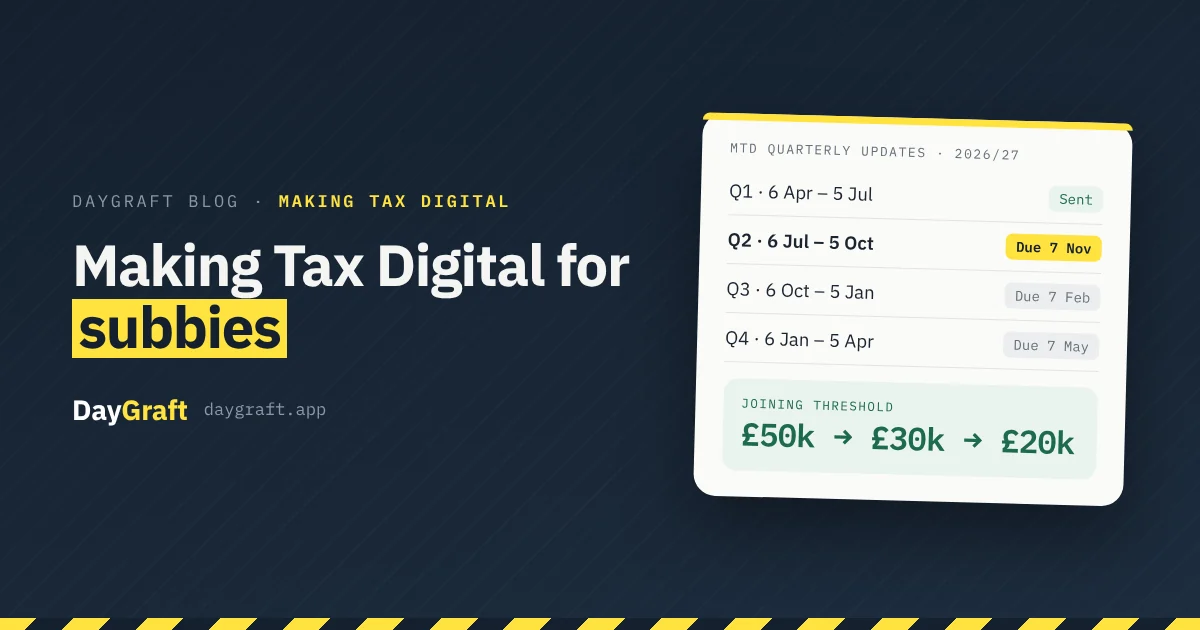
Making Tax Digital (MTD) for Income Tax means keeping your records in software and sending HMRC a short update every quarter, then finishing the year with your tax return through that software. It started on 6 April 2026 for self-employed people with income over £50,000. It reaches £30,000 from April 2027 and £20,000 from April 2028. For subbies, the threshold is your income before CIS is taken off. CIS itself doesn't change: it's still deducted the same way and settled at the end of the year.
Who has to join, and when
Whether you have to join depends on your qualifying income: your total self-employment and property income before expenses. For a subcontractor, that's everything contractors paid you before CIS was taken off. HMRC uses the figure from your tax return for an earlier year.
| You have to join from | If your qualifying income was over | In the tax year |
|---|---|---|
| 6 April 2026 | £50,000 | 2024/25 |
| 6 April 2027 | £30,000 | 2025/26 |
| 6 April 2028 | £20,000 | 2026/27 |
That catches far more subbies than people think. Over about 230 working days a year:
| Day rate | Roughly a year | MTD from |
|---|---|---|
| £100 | £23,000 | April 2028 |
| £150 | £34,500 | April 2027 |
| £220 | £50,600 | April 2026 |
HMRC writes to people it thinks need to join, but it's your responsibility to sign up in time. If you genuinely can't use a computer or the internet, for example because of age, disability or where you live, you can ask HMRC for an exemption.
What you actually have to do
- Keep your records digitally. Every bit of income and every expense goes into software (or a spreadsheet connected to bridging software) as you go, not in a shoebox until January.
- Send a quarterly update four times a year. It's a summary of your income and expenses for that quarter, sent from your software. It isn't a tax return, and you don't pay tax with it.
- Finish the year with your tax return, also sent through MTD software, by 31 January as before. That's where your allowances, your CIS and your final tax bill are worked out.
Your tax payment dates don't change. You still pay by 31 January (and 31 July if you make payments on account).
Quarterly deadlines for 2026/27
| Quarter | Covers | Update due |
|---|---|---|
| Q1 | 6 Apr – 5 Jul 2026 | 7 Aug 2026 |
| Q2 | 6 Jul – 5 Oct 2026 | 7 Nov 2026 |
| Q3 | 6 Oct 2026 – 5 Jan 2027 | 7 Feb 2027 |
| Q4 | 6 Jan – 5 Apr 2027 | 7 May 2027 |
| Tax return | The whole year | 31 Jan 2028 |
Your software can usually be set to calendar quarters (April to June, and so on) instead, if that suits you better.
What happens to your CIS
Nothing changes about CIS itself. Contractors still take 20% or 30% off your labour, and you still get monthly payment and deduction statements. What changes is how you report:
- Your quarterly updates include your income before CIS, plus your expenses.
- The CIS taken off during the year is set against your tax bill at the end of the year, on your tax return, just like now. If too much was taken, you get a refund. Here's how claiming CIS back works.
- Because you're entering things every quarter, it's easier to spot a missing statement or a short payment early.
Penalties
MTD uses a points system for late submissions:
- From 2027/28: each missed quarterly update or tax return deadline gets one point. At four points you get a £200 penalty, plus another £200 for each further miss. Points under the limit expire after 24 months.
- 2026/27, the first year: if you joined in April 2026, late quarterly updates don't get points. That easing doesn't cover a late tax return or paying your tax late.
Late payment has its own penalties and interest, as it does now. The simplest protection is to update your records every week, so each quarter is just a button press.
How to get ready
- Check your income. Look at your last tax return. Was your income before CIS and expenses over £50,000, £30,000 or £20,000?
- Choose MTD software that's recognised by HMRC, or a spreadsheet with bridging software. If you use an accountant, ask what they use, because many will submit for you.
- Sign up for MTD for Income Tax through GOV.UK before your start date.
- Start keeping records digitally now, even before you have to. A habit of logging days and receipts as they happen is most of the work.
Where DayGraft fits
To be straight about it: DayGraft is not yet HMRC-recognised MTD software, so it can't send your quarterly updates for you. What it does is keep the records MTD is built around. Every day's labour and materials, your expenses in HMRC-style categories with receipt photos, and your mileage are logged as you go. Settings shows each quarter's income and expenses with its deadline, and the next deadline counts down at the top. One tap exports any quarter as a CSV for your accountant, or for your MTD or bridging software. Sending updates straight to HMRC from the app is on our roadmap.
Sources (last checked 23 October 2026): MTD for Income Tax dates — GOV.UK (Making Tax Digital campaign) · Check if you need to use Making Tax Digital for Income Tax — GOV.UK · Find software for Making Tax Digital for Income Tax — GOV.UK · MTD for Income Tax penalties (13 August 2026) — Xero · MTD for Income Tax and CIS — Coconut
This guide is general information, not tax advice. If your situation is complicated, speak to an accountant or HMRC.